Back to Customer Stories
R-AI
Building the AI Brain Behind Paid Media Planning & Buying at Enterprise Scale
September 9, 2025
0
min reading time
About
Industry
AI: Media & Advertising
- First-to-market AI-powered paid media planning and buying platform.
- Full planning, activation materials and reporting intelligence.
- Built to replace the agency model with proprietary AI intelligence.
- 100+ publishers live on the platform.
- First live enterprise customer: NetApp.
- Currently in active VC funding stage.
Story Snapshot
- Uptic embedded as full product and platform team, vCTO included.
- Multi-agent AI architecture.
- 87% reduction in media planning time.
- Campaigns 50% faster to market; 15% performance uplift.
- NetApp AI governance review passed without remediation.
- Development brief to production in 9 months.
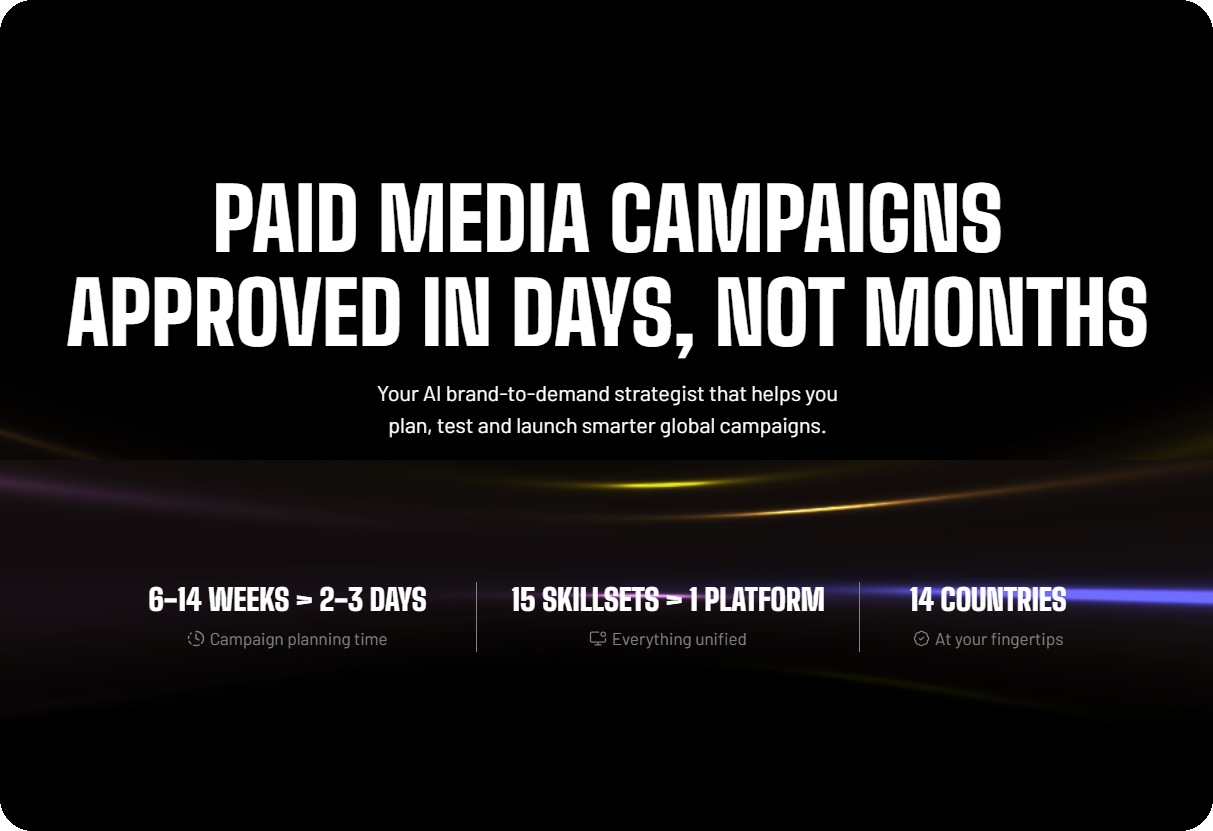
The paid media element of a campaign can take anywhere from 6 to 14 weeks just to plan and book.
- R-ai Technologies, 2026
INTRODUCTION
R-ai's founder wanted to compress that to 2 to 3 days, not by tinkering around the edges to make the existing process faster, but by replacing it entirely with a proprietary AI that encoded the deep expertise of an entire marketing team. Uptic built it.
Background
Marketers have a lot on their plate, building advertising campaigns that will move the needle in an incredibly competitive time.
Izzie Rivers has worked in media planning and buying for decades, and founded Realm, a global media agency. She realized early that AI was not going to make agencies more efficient; it was going to make their current set-up redundant. Her response was deliberate. Rather than wait to be disrupted, she founded R-ai to build the technology of the future.
The platform R-ai envisioned is a proprietary platform which empowers the client to complete heavy lifts fast in paid media: it's capable of taking their brief and producing a complete, agency-quality media campaign with channel strategy, publisher recommendations, budget allocations, and activation requirements. With closed-loop reporting, R-ai only gets more intelligent on what's working on a category and client specific level, making R-ai faster, more efficient and more intelligent than a human only approach.
Purpose-built for one domain, with the verified data, guardrails, and orchestration that general-purpose models cannot provide.
To build it, R-ai ran a competitive RFP for an external development team.
“Hiring AI expertise in this market is no joke. We needed a collaborative engineering team willing to go all in on AI transformation with us. Uptic's response was head and shoulders above the rest.”
- Izzie Rivers, CEO & Founder, R-ai Technologies
The Development Challenge
Building it required solving four technical problems simultaneously:
- A single LLM presented with full media planning requirements produces unusable and unreliable output. Essentially, it's not possible to do this as an LLM prompt! As context grows, reasoning quality degrades. The architecture had to solve this without sacrificing intelligence.
- Valuable or commercial data cannot be hallucinated. Publisher rates, budget allocations, and performance calculations have to be correct. Any inaccuracy makes the plan unusable.
- AI procurement is tough, for good reason. Clients require complete data isolation, audit trails, and governance compliance. Security had to be at the center of the platform from day one, not retrofitted later.
- R-ai had clients already interested and wanted to capitalize on this while positioning for funding. This required a team that could adapt sprint priorities around investor meetings, client onboarding, and security audits in real time.
Every other RFP response proposed a 6-month discovery phase and a fixed team structure with no guarantee of AI engineer expertise. That was not what the engagement required.
The Solution
Uptic embedded as R-ai's full product and platform team, with Nicky Willebrand as CTO from inception. Every engineering role, architect, AI engineer, front-end, back-end, platform, resource, security, and QA, was provided on a needs basis, scaling with the project. The team adapted sprint priorities in real time to meet immediate business needs, whether that was a VC meeting, a client onboarding, or a security audit.
Uptic's assessment was clear from the outset: no existing AI system can handle the complex planning to buying tasks required for paid media, and no single agent or simple LLM wrapper ever could. R-ai needed to be a fully orchestrated platform, where AI, deterministic logic, verified publisher data, and human oversight work in concert across the entire paid media lifecycle, not a collection of AI agents bolted together. That starts with context: the more an LLM holds, the less coherent its reasoning becomes, so the architecture was built around separate, focused agents with tightly constrained context windows, each receiving only what its task requires. Agents run in parallel where possible, with automatic regional failover on AWS Bedrock handling latency before it ever reaches the user.
"As we decomposed the system into a tighter multi-agent architecture, with each agent given a very specific focus, the quality of results increased exponentially. That was the breakthrough."
- Nicky Willebrand, vCTO, R-ai Technologies
Key capabilities Uptic designed and built:
- Multi-agent orchestration. Each planning stage runs as a focused agent with constrained context, maintaining output quality across a complex multi-step workflow.
- Hallucination controls. A verified publisher database, automated output validation at every stage, and deterministic business rules combine to eliminate unreliable financial data.
- AWS Bedrock with a frontier model. A mixture-of-experts architecture giving large-model reasoning at production-grade latency, with automatic regional failover and private local model hosting for sensitive workloads.
- Enterprise security by design. Per-tenant database isolation, no cross-tenant data, no fine-tuning on client data, continuous code and cloud security scanning through Aikido, and a full enterprise-grade security stack, built in from day one.
- Enterprise-grade AWS infrastructure. Fully defined as code, ensuring consistent, secure, and reproducible deployment across regions, with OpenTelemetry-based observability through Dash0 across the agent pipeline.
- Automated AI testing. End-to-end tests validate full conversational workflows before every release, catching output degradation before it reaches users.
Built using devOS, Uptic's proprietary agentic development harness. To manage the complexity of building multi-agent AI applications at speed, Uptic has developed a proprietary approach to agentic software development, a control plane for building and validating AI-native systems, enabling parallel agent development and rigorous, spec-driven validation before any code reached production. That technology, proven on R-ai, is now core to how Uptic builds every complex AI product.
Outcomes
R-ai became an enterprise-ready platform in 9 months. Results are from the beta period with NetApp.
- Planning time: 87% reduction in overall media planning time.
- Speed to market: Campaigns to market 50% faster than the previous process.
- Working media: Lower fees increased working media spend.
- Performance: 15% improvement in campaign performance versus baseline during the POC.
- Enterprise security: AI governance review passed without remediation.
- Knowledge retention: Institutional knowledge preserved and compounding with every campaign.
"It's allowed our business to evolve into a world where we can operate on the future of work and redesign around something that allows our staff to exist in that future."
- Izzie Rivers, CEO, R-ai Technologies
Share this post


%201.png)